Esta página solo está disponible en inglés. Ir a la portada en español

×

Questa pagina è disponibile solo in inglese. Home page in italiano

×

Diese Seite ist nur auf Englisch verfügbar. Zur deutschen Startseite

×

Cette page est disponible uniquement en anglais. Aller à la page d'accueil en français

×

Schmitz Cargobull expands S.CU transport cooling unit range

Schmitz Cargobull expands S.CU transport cooling unit range

Schmitz Cargobull has expanded its range of transport cooling units with new diesel and electric models, including the S.CU d80, S.CU dc85, and the all-electric S.CU ep85. The S.CU dc85 and S.CU ep85 are also available as MultiTemp versions. The company highlights simplified maintenance and reliable operation across the updated product line.

All S.CU units feature a wide door opening and an accessible layout of diesel and oil filters to streamline maintenance. Electrified cooling circuits reduce the number of components requiring servicing. A microchannel condenser and defined airflow through the engine chamber are designed to ensure high operating reliability under extreme temperatures. Integrated electric heating elements and extended slat spacing enable more efficient defrosting, reducing defrost cycles by 30%.

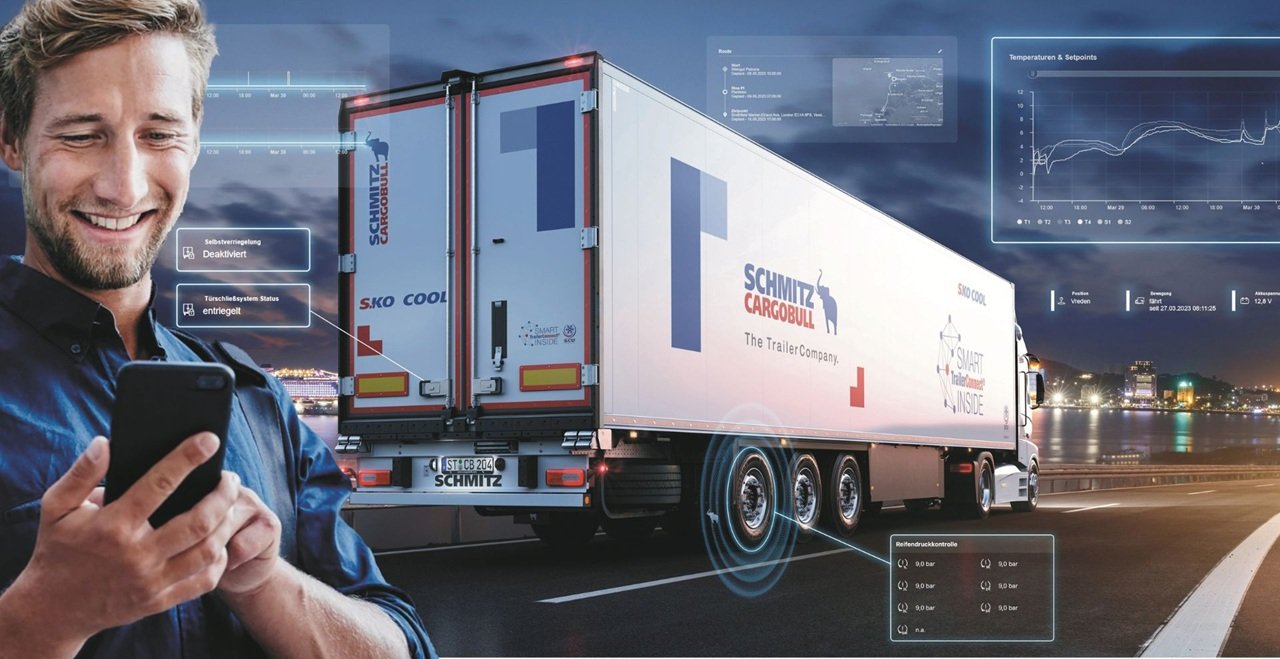
A standard feature across the range is the Silence Kit, which lowers noise levels without affecting performance. Telematics solutions such as CargoSets and RemoteStart are integrated, supporting transport configuration and remote activation. Each S.CU unit includes a 24-month Full Service contract with TrailerConnect telematics and Smart Service for real-time monitoring and fault diagnosis.

The S.CU d80 is now available with an optional electric power take-off (ePTO) for emission-free operation via an electric tractor unit. This configuration eliminates the need for a separate high-voltage battery in the trailer. The unit automatically switches to diesel mode if no electric power is available.

The S.CU dc85 features diesel common rail technology and intelligent partial-load control to optimize fuel consumption. Its electronic speed control enables precise temperature management. The MultiTemp version includes a partially recessed evaporator and protective frame to preserve maximum interior height. TrailerConnect functionalities, including RemoteStart and CargoSets, are integrated as standard.

Schmitz Cargobull continues to offer its cooling units within a modular system framework, supporting custom configurations, quick spare part availability, and efficient serviceability.
Get the daily refrigeration briefing

One email a day. Trusted by 3,000+ RACHP professionals.

More on Cold Chain

All on Cold Chain →

Insights

Secop's Solar Direct Drive (SDD) System Earns WHO PQS Approval – The Team Behind It
Article

Secop’s Solar Direct Drive (SDD) System Earns WHO PQS Approval – The Team Behind It

Partner's material In March 2026, Secop’s Solar Direct Drive Power Management Module was granted WHO PQS prequalification and officially listed in the WHO Catalogue of Prequalified Immunization Devices. The WHO IMD-PQS (Immunization Devices Performance, Quality and Safety programme) is the global benchmark for cold chain equipment used in immunisation. Being listed in its catalogue is

22 Jun 2026
Case Study - Effect of Louvers or diffusers on air flow distribution and cooling time on a meat log during Chill cycle
Tech Guide

Case Study – Effect of Louvers or diffusers on air flow distribution and cooling time on a meat log during Chill cycle

By Kushal Aurangabadkar An experimental analysis was conducted on a cooler space measuring 3.66 m × 6.096 m (12.0 ft × 20.0 ft), equipped with an ammonia refrigeration coil, five 30 cm (12 in.) fans, and five diffusers. The study measured airflow patterns, cooling rates, and heat transfer efficiency in meat storage by testing two configurations:

Kushal Aurangabadkar · 21 Jan 2026
Total Cost of Ownership (TCO) for Modular Refrigeration Systems in Life Sciences Distribution Centers
Tech Guide

Total Cost of Ownership (TCO) for Modular Refrigeration Systems in Life Sciences Distribution Centers

by Ramez Naguib, P.E. Introduction Life sciences distribution centers are under immense pressure to deliver consistent temperature control, comply with increasingly stringent regulations, and optimize operational efficiency. Traditional built-up refrigeration systems often prove cumbersome, costly, and slow to implement. In contrast, modular, factory-assembled refrigeration systems have emerged as a compelling alternative. Drawing on lessons from

14 Jan 2026
Everything on Cold Chain: 2,039 articles, 1 case study, 23 insights

Most read this month

All news →