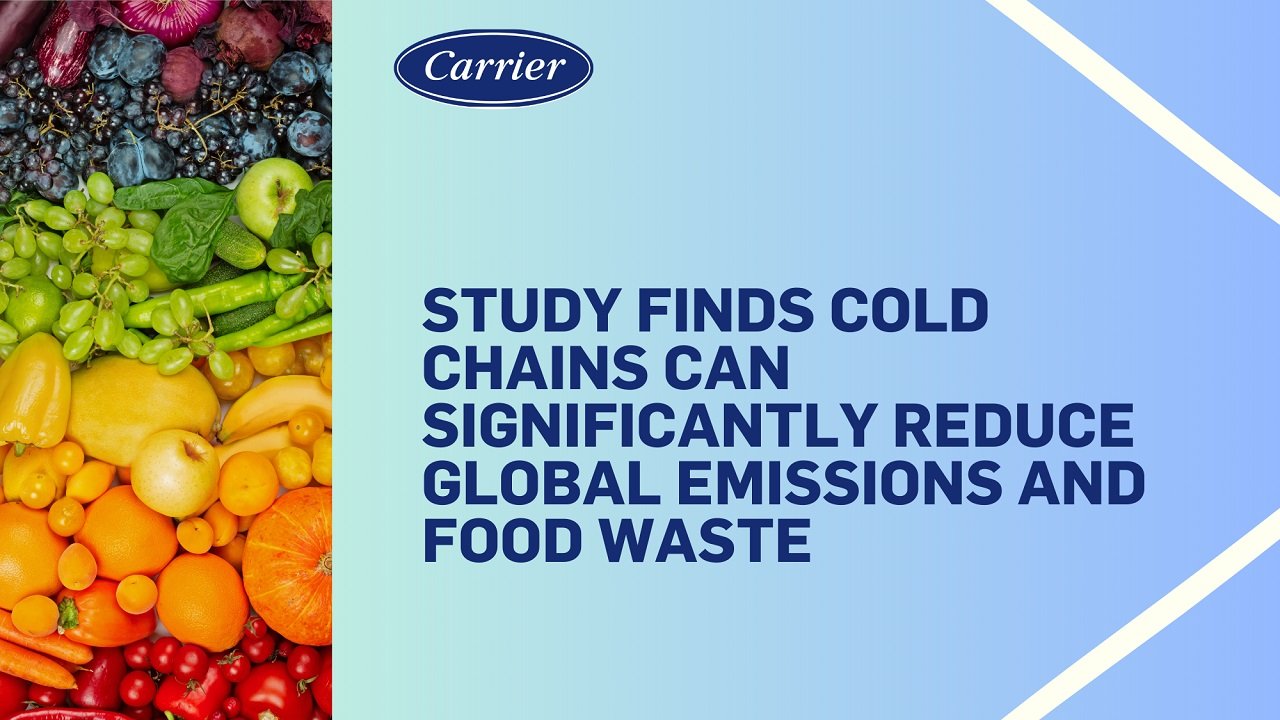
A new study by the University of Michigan, supported by the U.S. National Science Foundation and Carrier Global Corporation (NYSE: CARR), global leader in intelligent climate and energy solutions, found that nearly half of the 1.3 billion tons of global food wasted each year could be prevented with fully refrigerated food supply chains. This is critical as about a third of the food produced worldwide is wasted annually, while approximately 800 million people suffer from hunger. The study also concluded that fully refrigerated supply chains have the potential to reduce global food waste-related emissions of climate-warming greenhouse gases by 41%.
“At Carrier, we recognize that connected cold chains are essential in the fight against food loss/waste and the associated carbon emissions, and we’re proud to offer refrigeration products and solutions that preserve, protect and extend the supply of fresh food, as well as lifesaving medicine and other perishable goods around the globe,” said Kori Recalde, Senior Director, Environmental, Social & Governance, Carrier. “We’re pleased to support important research such as the University of Michigan’s study to raise awareness and understanding of this critical issue.”
The study’s researchers built a food-loss estimation tool to assess how improved access to the cold chain could impact food loss and its associated emissions for seven food types in seven regions, using data from the U.N. Food and Agriculture Organization and other sources.
By modeling food losses at each stage of the supply chain, the study highlights where the cold chain can be optimized to reduce food losses and emissions. The researchers analyzed the effects of moving from the current state of inconsistent and variable-quality cold chains throughout the world to an optimized system with high-quality refrigeration across all stages.
“The scale of our opportunity for reducing food loss and waste globally is evident,” said the study’s lead author Aaron Friedman-Heiman, a master’s student at University of Michigan’s School for Environment and Sustainability and at the Ross School of Business. “Approximately half of the roughly 1.3 billion tons of food that goes to waste annually can be solved through food supply-chain optimization.”
The study emphasizes the disparity in cold chain infrastructure between developed and developing countries. Regions such as Sub-Saharan Africa and South and Southeast Asia are highlighted for their significant potential to reduce both food loss and related emissions through enhanced cold-chain implementation.
The research also sheds light on the environmental impact of different types of food, revealing that meat accounts for more than 50% of food loss-related greenhouse gas emissions, despite representing less than 10% of global food losses by weight. Optimized refrigeration of meat alone could eliminate more than 43% of emissions associated with meat loss.
The findings of the University of Michigan study serve as a call to action for all stakeholders in the food supply chain, from farmers to government officials, to embrace optimized refrigeration to combat food waste and mitigate climate change.
Published in the peer-reviewed journal Environmental Research Letters, the study was co-authored by Shelie Miller, a professor at the University of Michigan School for Environment and Sustainability and at the College of Engineering.
Read the study entitled “The impact of refrigeration on food losses and associated greenhouse gas emissions throughout the supply chain.”