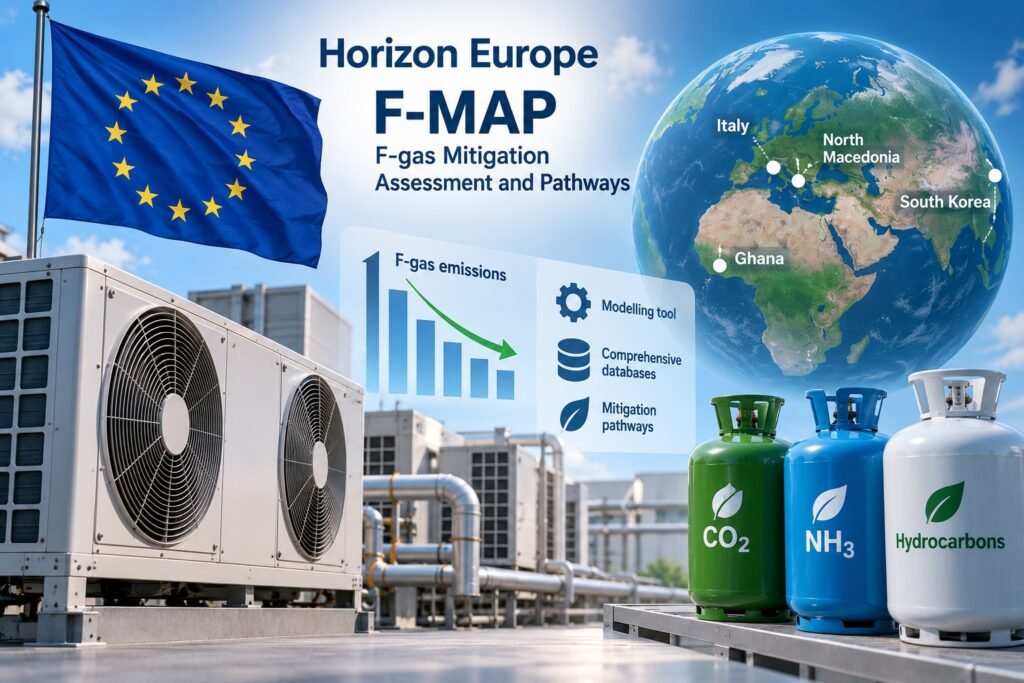
The EU-funded F-gas Mitigation Assessment and Pathways (F-MAP) project has launched under the Horizon Europe programme to develop science-based tools for reducing fluorinated greenhouse gas (F-gas) emissions. The initiative focuses on refrigeration, air conditioning, heat pumps and other industrial applications where F-gases are widely used.
F-MAP will develop an open-source modelling tool to identify and evaluate cost-optimal and emission-optimal F-gas mitigation pathways. The tool will incorporate technological, economic, environmental and socio-technical factors to help researchers, industry stakeholders and policymakers compare emission reduction scenarios.
The project will also establish databases covering F-gas emissions, equipment leakage rates, mitigation technologies and their technical and economic performance. These resources will support assessments of emission reduction opportunities and the transition to natural refrigerants, including CO2, ammonia (NH3) and hydrocarbons.
Four regional case studies will be conducted in Italy, Ghana, South Korea and North Macedonia. They will examine F-gas mitigation strategies under different climatic, economic, technological and regulatory conditions.
Coordinated by SINTEF Energy Research in Norway, the three-year project runs from September 2026 to August 2029 and receives approximately €2.99 million (US$3.2 million) in EU funding. Its consortium includes research institutions, universities and industry partners from Europe, Africa and Asia.
F-MAP aims to support implementation of the EU F-gas Regulation and international climate commitments, including the Kigali Amendment to the Montreal Protocol. The project forms part of Horizon Europe’s Climate, Energy and Mobility research activities.