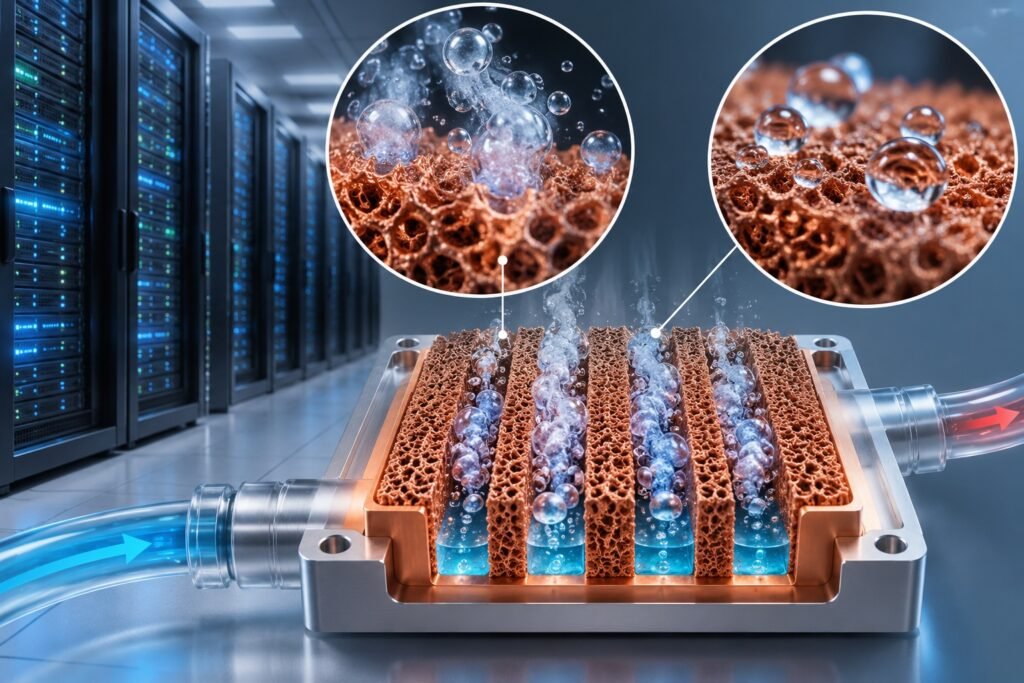
Researchers from Shandong University and RMIT University have developed a microstructured superhydrophobic copper-foam evaporator with embedded minichannels for mechanically pumped two-phase loop (MPTL) cooling. The 500 PPI copper-foam design simultaneously achieved a critical heat flux (CHF) of 414.5 W/cm² (approx. 1.31 million BTU/h·ft²) and a heat transfer coefficient (HTC) of 77.5 kW/(m²·K) (approx. 13,650 BTU/h·ft²·°F) at a coolant mass flux of 66 kg/(m²·s) (approx. 13.5 lb/ft²·s).
The evaporator combines 500 pores-per-inch (PPI) copper foam with minichannels and a superhydrophobic surface. According to the study, the high-PPI structure increases heat-transfer area and nucleation sites, while the minichannels and surface treatment regulate vapor escape and liquid replenishment. Deionized water was used as the working fluid in flow-boiling experiments.
The copper foam was machined to create four parallel channels and chemically modified using 1H, 1H, 2H, 2H-perfluorodecyltriethoxysilane (PFTS). Researchers investigated copper foams with different pore densities and wettability and used high-speed visualization to examine bubble nucleation, growth and departure.
For superhydrophobic copper foams with 100, 500 and 1000 PPI, the study reports CHFs of 380.2, 414.5 and 289.3 W/cm² (approx. 1.21 million, 1.31 million and 917,000 BTU/h·ft²), respectively, with corresponding HTCs of 71.7, 77.5 and 46.8 kW/(m²·K) (approx. 12,630, 13,650 and 8,240 BTU/h·ft²·°F). The researchers found that pore density, surface wettability and channel confinement jointly influence bubble behavior and vapor-liquid separation.
The authors propose the evaporator for high-heat-flux thermal management, particularly for edge data centers, and state that future work will examine system-level integration and long-term operation under realistic data-center conditions.